Skip to content
No sign-up · no adsGet new tools by email
Clean Pixel Studios

Rental Property Analysis

Enter the price, loan, rent and expenses to see one property's monthly cash flow, cap rate and cash-on-cash return.

You typeWe calculate

How it's calculated

NOI       = income − vacancy − expenses
Cash flow = NOI − mortgage (P&I)
Cap rate  = NOI ÷ price
Cash-on-cash = yearly cash flow ÷ cash in

Expenses here are operating costs only. The mortgage comes out after NOI, which is why cap rate ignores how you finance the deal.

Sources and worked example
Monthly cash flow$152After the mortgage and every expense · $1,824 a year
Positive cash flow
Cap rate7.12%
Cash-on-cash return3.17%
NOI per year$17,791
DSCR1.11
Mortgage (P&I)$1,330.60
Cash invested$57,500
Monthly breakdown
Rent and other income$2,400

An estimate for comparing properties, not financial or tax advice. Check taxes, insurance and rents locally.

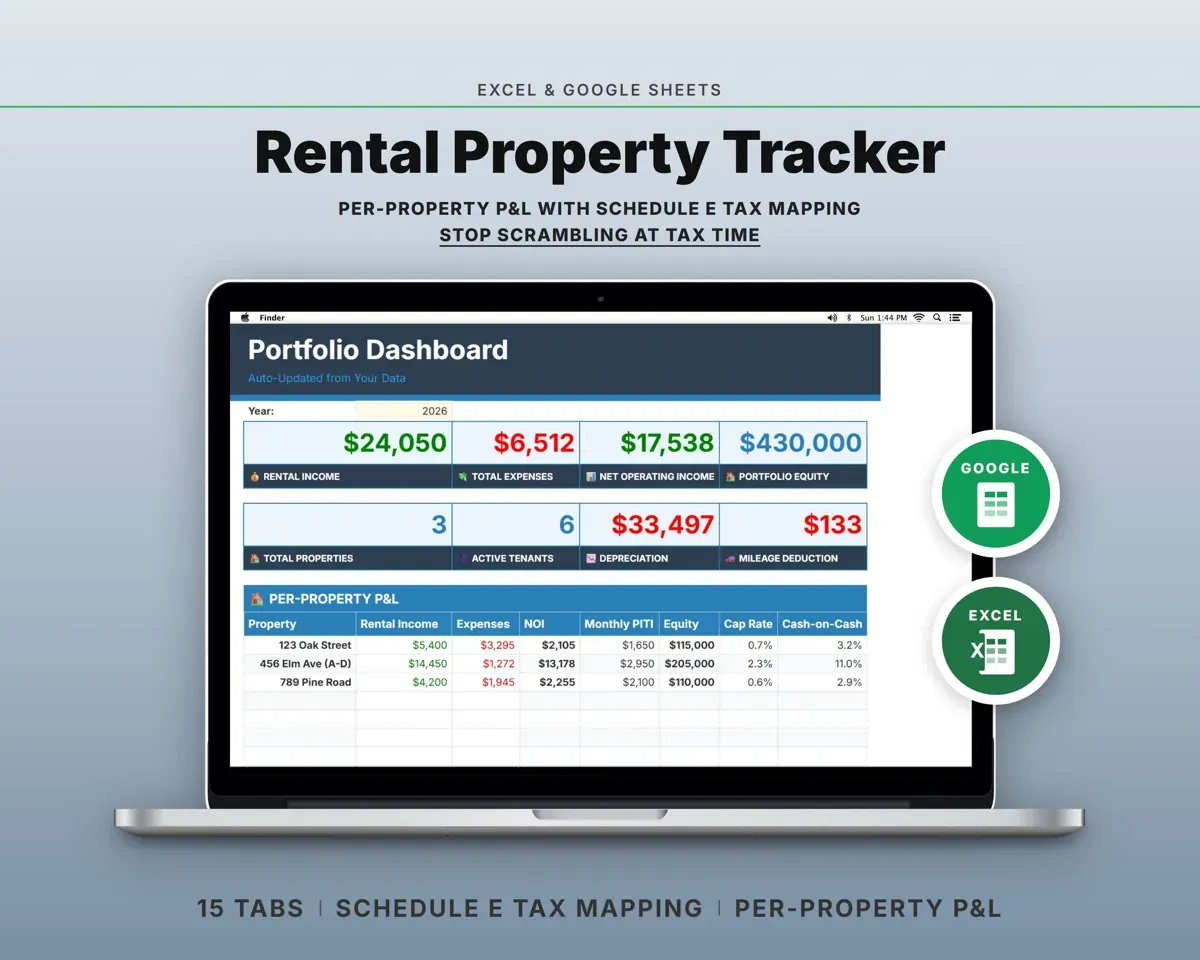
Rental Property Spreadsheet preview
The full template

Track every rental, tenant and Schedule E line

  • Per-property P&L with NOI, cap rate and cash-on-cash return
  • Every expense mapped to its Schedule E line
  • Depreciation for 27.5-year property and improvements
  • Leases expiring in the next 90 days flagged
Rental Property Spreadsheet$19.99One-time · instant downloadCheckout opens soonExcel + Google Sheets + PDF guide5.0 shop rating on Etsy

How to analyze a rental property

A rental is worth buying when the rent covers every cost of owning it and leaves enough left over for the risk you take on. This calculator works through that in the same order a lender or experienced investor would: income, then operating expenses, then the mortgage.

1. Income after vacancy

Start with monthly rent plus any other income, such as laundry or parking. No property is rented every day of the year, so subtract a vacancy allowance. The result is the income you can expect to actually collect.

2. Operating expenses and NOI

Operating expenses are the costs of running the property: property tax, insurance, HOA dues, owner-paid utilities, repairs, a reserve for big replacements like a roof or water heater (capital expenses), and property management. Income after vacancy minus operating expenses is net operating income (NOI). NOI leaves out the mortgage, so it describes the property, not your loan.

3. Cap rate

Cap rate is yearly NOI divided by the purchase price. It is the return you would earn paying all cash, which makes it useful for comparing properties with each other.

4. Cash flow, cash-on-cash return and DSCR

Subtract the monthly mortgage payment (principal and interest) from NOI to get cash flow.Cash-on-cash return is a year of cash flow divided by the cash you put in: the down payment plus closing costs and up-front repairs. DSCR (debt-service coverage ratio) is NOI divided by a year of mortgage payments. Above 1.0 means the property's income covers the loan; many lenders look for around 1.2 or more on investment loans.

Worked example

A $250,000 house with 20% down, a 7% 30-year loan and $7,500 in closing costs, renting for $2,400 a month. Taxes are $3,000 a year, insurance $1,500, with 5% vacancy, 5% repairs, 5% capital expenses and 8% management.

Worked example, monthly
Rent$2,400.00
Less 5% vacancy−$120.00
Property tax−$250.00
Insurance−$125.00
Repairs and maintenance−$120.00
Capital expenses−$120.00
Property management−$182.40
NOI$1,482.60
Mortgage on $200,000−$1,330.60
Cash flow$152.00

That is $17,791 of NOI a year, a cap rate of 7.12%, and $1,824 of yearly cash flow on $57,500 invested: a 3.17% cash-on-cash return with a DSCR of 1.11. Rent is 0.96% of the price, just under the 1% rule.

Sources

FAQ

Common questions

What is a good cap rate for a rental property?

There is no single number. Cap rates depend on the market and the property type, and lower cap rates usually come with lower risk or stronger appreciation. Compare a property to similar ones in the same area rather than to a national rule.

What is the difference between cap rate and cash-on-cash return?

Cap rate ignores financing: it is NOI divided by the price, as if you paid cash. Cash-on-cash return is your yearly cash flow after the mortgage divided by the cash you actually put in, so it changes with your down payment and interest rate.

Does NOI include the mortgage payment?

No. Net operating income is income minus operating expenses (taxes, insurance, repairs, management and so on). The mortgage is a financing cost, so it comes out after NOI to get cash flow.

What is the 1% rule?

A quick screen that says monthly rent should be at least 1% of the purchase price. It is only a filter for deciding what to analyze; plenty of good deals miss it and plenty of bad ones pass. Run the full numbers either way.

What percentages should I use for maintenance, capital expenses and vacancy?

Many investors start with about 5% of rent each for vacancy, repairs and capital expenses, then adjust for the age and condition of the property and how fast units rent in the area. Use your own history when you have it.

More free tools