Skip to content
No sign-up · no adsGet new tools by email
Clean Pixel Studios

PTO Accrual Calculator

Pick how your PTO builds up: per hour worked, per pay period or once a year. You get the hours earned each paycheck, the rate per hour, and your balance on any date.

Accrual policy & pay schedule

Schedule:
Allowance:

Starting balance, hours used & target date projection

You typeWe calculate

How it's calculated

Per pay period = hours per year ÷ pay periods
Per hour worked = hours per year
                  ÷ (hours per week × 52)
Balance = starting balance + hours earned
          − hours used

Accrual is credited at the end of each week or pay period, or on the grant date for a lump sum. The cap is checked at each accrual and the carryover limit on each January 1.

Sources and worked example
PTO balance48.6 hours6.1 days of 8 hours · as of Oct 23, 2026
Next: +3.08 h on Nov 5, 2026
Accrual & target date summary: You earn 3.08 hours per pay period (every two weeks (26), or 0.0385 hrs per hour worked). Between Jan 1, 2026 and Oct 23, 2026, you accrue 64.6 hours across 21 accruals and use 16 hours, leaving 48.6 hours (6.1 days) available. No balance cap is active.
Earned since start64.6 hours
Per year80 hours (10 days)
Rate per hour worked0.0385
Works out to1 hour per 26 worked
Hours earned per pay period
Pay scheduleHours each paydayDays each payday
Weekly (52)1.54 hrs0.19 days
Every two weeks (26)3.08 hrs0.38 days
Twice a month (24)3.33 hrs0.42 days
Monthly (12)6.67 hrs0.83 days
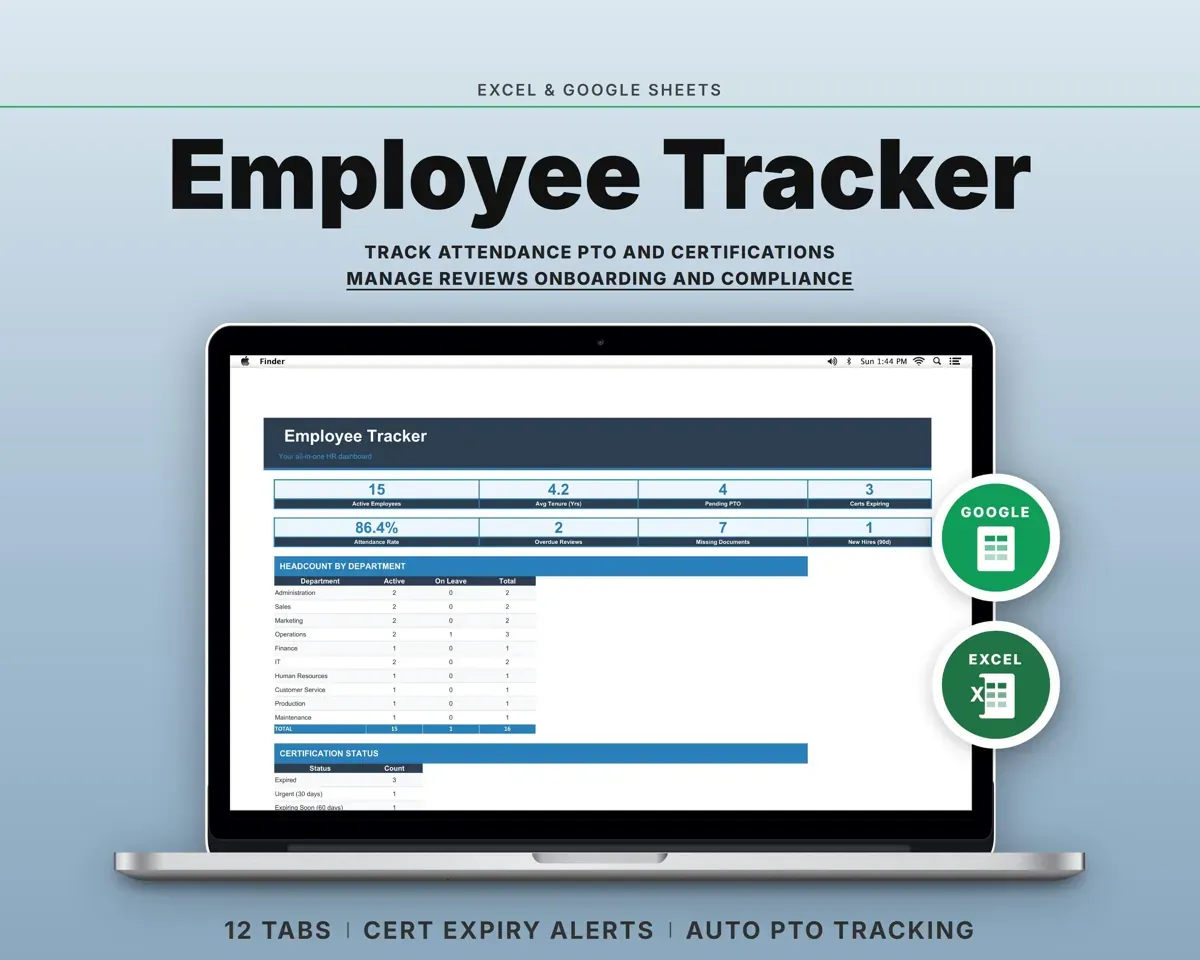
Tracking team leave & attendance:At 80 hours a year (10 workdays), keeping track of requests, approvals and days taken across a team adds up fast. The Employee Tracker Spreadsheet logs every vacation and sick leave request by employee, counts business days off, flags pending approvals on the dashboard, and tracks daily attendance and overtime.

Setting or tracking PTO for a team?

An estimate for planning, not legal or HR advice. Your employer's written policy and your state's law decide what you actually earn.

Employee Tracker Spreadsheet preview
The full template

Keep every PTO request, approval and day off on record

  • PTO Tracker logs each request by leave type and counts the business days off
  • Approval status and approver on every request, with pending requests on the Dashboard
  • Attendance Log records hours worked each day and works out overtime
  • Employee Directory with hire dates and tenure, plus certifications, reviews and onboarding
Employee Tracker Spreadsheet$17.99One-time · instant download
Excel + Google Sheets + PDF guide5.0 shop rating on Etsy

How the PTO accrual calculator works

Paid time off builds up under the rules in your employer's policy. Federal law doesn't require paid vacation, so there is no single formula, but nearly every policy uses one of three methods. Pick yours, enter the numbers from your handbook or pay stub, and the calculator walks through every accrual date between the start date and the date you choose.

1. Per hour worked

You earn a fixed amount for each hour on the clock, such as 1 hour for every 30 worked. This is common for paid sick leave and for part-time staff. California's paid sick leave law sets that 1-for-30 rate as the minimum. The calculator credits it weekly from your usual hours per week, so overtime and short weeks will move the real number a little.

2. A set amount each pay period

The yearly amount is split across your paychecks: 52 a year if paid weekly, 26 every two weeks, 24 twice a month and 12 monthly. Twice-a-month accruals land on the 15th and the last day of the month. Federal employees work this way: the Office of Personnel Management credits annual leave each biweekly pay period based on years of service.

Federal annual leave accrual
Federal servicePer pay periodPer year
Less than 3 years4 hours104 hours
3 to 15 years6 hours (10 in the last period)160 hours
15 years or more8 hours208 hours

3. All at once each year

Some employers front-load the year's PTO on January 1 or on each work anniversary. The calculator grants the full amount on your start date and again on each grant date. If your employer prorates the first year, enter the prorated hours as your starting balance and start from the next grant date.

4. Caps, carryover and hours used

A cap stops accrual while your balance is at the limit, and the calculator shows when you'll hit it if you take no time off. A carryover limit trims the balance on January 1, and anything above it is lost. Hours used are subtracted at the end. If your balance was near the cap when you took time off, start from that date and balance instead for the most accurate result.

Worked example

An employee starts on Jan 1, 2026 with 80 hours of PTO a year (10 days), paid every two weeks, and takes 16 hours off. Each payday adds 80 ÷ 26 = 3.08 hours. By Oct 23, 2026 there have been 21 paydays, for 64.62 hours earned. Minus the 16 hours used, the balance is 48.62 hours, or 6.1 days. The next payday adds 3.08 hours on Nov 5, 2026.

The same 80 hours over a 40-hour week, 2,080 hours a year, is a rate of 0.0385 hours per hour worked, or about 1 hour per 26 worked.

Under a 1-for-30 sick leave policy, the same full-time worker earns 1.33 hours a week and 69.3 hours a year. With an 80-hour cap and no sick days taken, the balance reaches 80 hours on Feb 25, 2027 and stops growing until some is used.

Where the sources differ

2,080 or 2,087 hours. This calculator uses 40 hours × 52 weeks = 2,080 hours for a full-time year. OPM uses 2,087 hours when it converts federal salaries to hourly rates, because a calendar year has 365 or 366 days, not 364. The difference changes the rate per hour by about 0.3%.

When accrual is credited. Some payroll systems credit PTO on the payday, some at the end of the pay period and some daily. The yearly total is the same, but your balance on a given day can differ by one period's worth.

Law vs. policy. Vacation is a matter of company policy under federal law, but paid sick leave rules vary by state and city. Where a local law sets a minimum, such as California's 1 hour per 30 worked, your employer's policy has to meet it.

Sources

FAQ

Common questions

How is PTO accrual calculated?

Most policies use one of three methods. Per hour worked: you earn a set amount for every hour, such as 1 hour for every 30 worked. Per pay period: the yearly amount is divided by the number of paychecks, so 80 hours a year paid every two weeks is 80 ÷ 26 = 3.08 hours each payday. Lump sum: the whole year is granted at once, often on January 1 or your work anniversary.

How many hours of PTO do I get per pay period?

Divide your yearly PTO hours by the number of pay periods. Ten days (80 hours) is 1.54 hours a week, 3.08 hours every two weeks, 3.33 hours twice a month or 6.67 hours a month. Fifteen days (120 hours) is 4.62 hours every two weeks.

What is the PTO accrual rate per hour?

Divide the yearly PTO hours by the hours worked in a year. A full-time year is 40 × 52 = 2,080 hours, so 80 hours of PTO is 80 ÷ 2,080 = 0.0385 hours per hour worked, or about 1 hour for every 26 hours. Part-time workers on an hourly policy earn the same rate on fewer hours.

How much PTO is normal?

The Bureau of Labor Statistics found that private industry workers averaged 11 paid vacation days after 1 year of service in March 2026, 16 after 5 years, 18 after 10 years and 20 after 20 years. Paid sick leave averaged 7 days a year.

Is paid time off required by law?

Not under federal law. The U.S. Department of Labor says the Fair Labor Standards Act does not require pay for time not worked, such as vacations or sick leave; those benefits are an agreement between employer and employee. Some states and cities do require paid sick leave. California, for example, requires at least 1 hour for every 30 hours worked.

What happens to unused PTO at the end of the year?

It depends on the policy and your state. Some employers let all of it carry over, some cap how much carries over, and some cap the total balance so you stop earning once you reach it. California lets employers cap a paid sick leave balance at 80 hours or 10 days. Enter your policy's cap and carryover limit to see their effect.

More free tools