
How fly line weights work
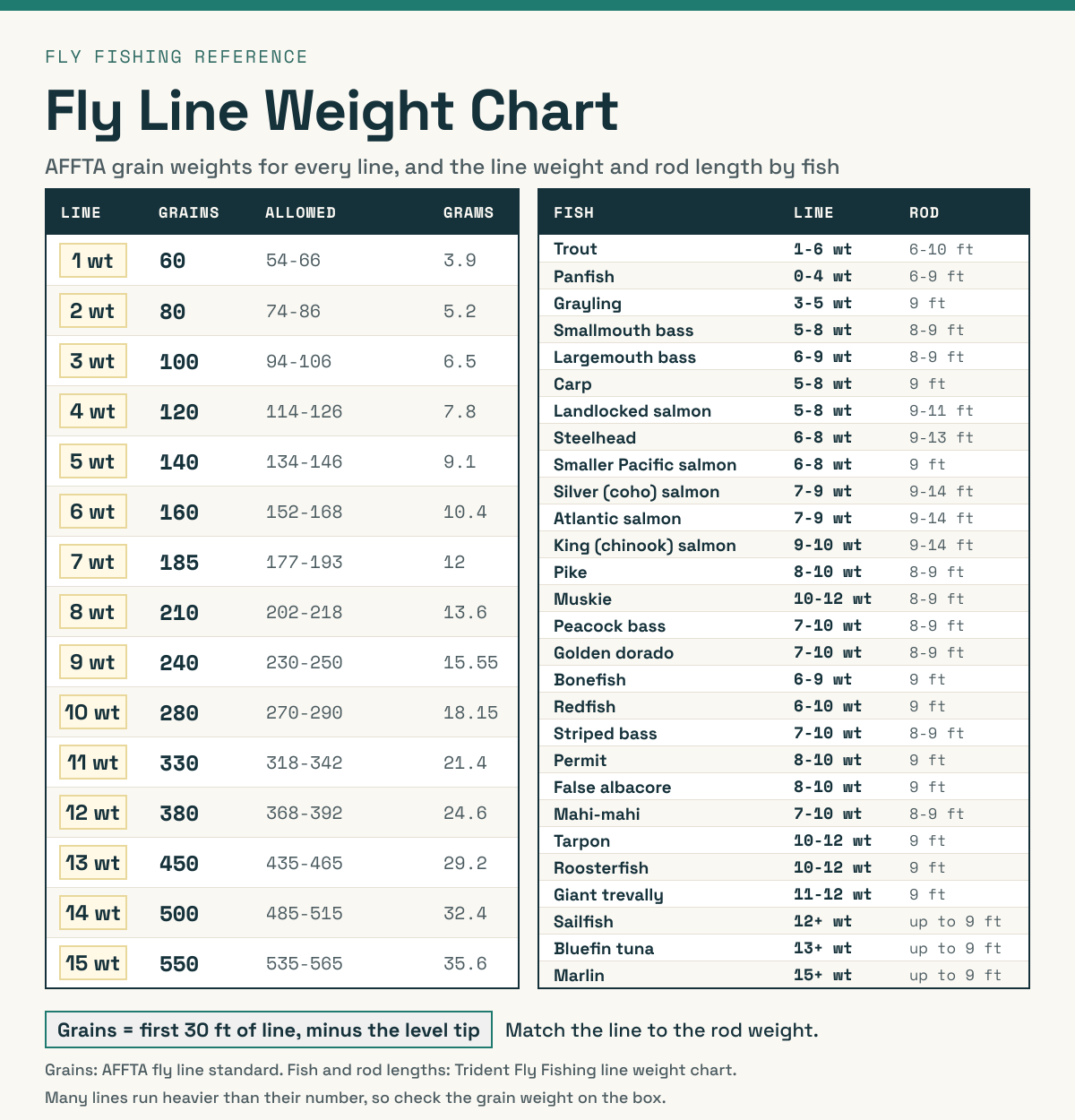
A fly line's number is a weight class set by the American Fly Fishing Trade Association (AFFTA). It is the weight in grains of the first 30 feet of the line, not counting the thin level tip at the end. The scale runs from 1 wt at 60 grains to 15 wt at 550 grains, and each size allows a few grains either side: a 5 wt can weigh 134 to 146. The standard dates from 1961, when 30 feet was thought of as a typical trout cast.
Pick the weight for the fish and the fly
Bigger fish, bigger flies and bigger water call for heavier lines. Orvis's rule is that heavier lines cast farther, cut through wind on saltwater flats and big rivers, and push big, heavy flies through the air, while lighter lines put small flies down gently. That is why the chart above gives a range: the light end is for small flies and calm water, the heavy end for wind, big flies and the biggest fish. Trident and Orvis disagree on a few fish, mostly saltwater ones like mahi-mahi and permit, so the picker shows both.
Match the line to the rod
A rod's weight is the line size it was built to cast, so a 5 wt rod takes a 5 wt line, and the reel should be rated for that weight too. Orvis says you can get by within 1 to 2 weights of the ideal for a piece of water, which is why one 5 wt rod covers most trout fishing.
Up-lining, and lines that already run heavy
Up-lining means putting a line one size heavier than the rod's rating on it. Tom Rosenbauer at Orvis says you can usually go about one line size heavier, depending on the rod. The extra weight bends the rod more and slows it down: short casts get easier, long casts harder. It helps on stiff, fast rods, for short casts and with big flies. Going lighter does the opposite; the rod doesn't bend enough and you have to push the line out.
Check the box before you up-line, because many lines already run heavy. Some are built a full size heavy on purpose, and Fly Fisherman found 6 wt lines weighing anything from 160 to 235 grains. The grain weight printed on the box tells you what you have. Type it into the checker above to see its real AFFTA weight.
Worked example: a bonefish rod
The chart gives bonefish 6 to 9 wt on a 9 ft rod, and Trident says most anglers pick a 9 ft 8 wt. By the AFFTA standard an 8 wt line weighs 210 grains in its first 30 feet (202 to 218 allowed).
- Up-lining that rod to a 9 wt line adds 30 grains: 240 instead of 210.
- Fly Fisherman notes that RIO's DirectCore Flats Pro runs one size heavy: its 8 wt weighs 240 grains. The checker says: 240 grains is a 9 wt by the AFFTA standard (230 to 250 grains). So that line on an 8 wt rod is already up-lined by one size.
Once the line is on, the leader and tippet come next. The tippet size chartmatches the tippet to your fly size.
Fly line weight by species
Line weight and rod length from Trident Fly Fishing's chart, with Orvis's range where it names the fish.
| Fish | Line weight | Rod length | Orvis |
|---|---|---|---|
| Trout | 1 to 6 wt | 6 to 10 ft | 1 to 6 wt |
| Panfish (bluegill, crappie) | 0 to 4 wt | 6 to 9 ft | 1 to 4 wt |
| Grayling | 3 to 5 wt | 9 ft | 5 wt |
| Smallmouth bass | 5 to 8 wt | 8 to 9 ft | 6 to 7 wt |
| Largemouth bass | 6 to 9 wt | 8 to 9 ft | 6 to 7 wt |
| Carp | 5 to 8 wt | 9 ft | 6 to 8 wt |
| Landlocked salmon | 5 to 8 wt | 9 to 11 ft | 6 to 8 wt |
| Steelhead | 6 to 8 wt | 9 to 13 ft | 6 to 10 wt |
| Smaller Pacific salmon (pink, sockeye, chum) | 6 to 8 wt | 9 ft | 6 to 8 wt |
| Silver (coho) salmon | 7 to 9 wt | 9 to 14 ft | 6 to 8 wt |
| Atlantic salmon | 7 to 9 wt | 9 to 14 ft | 6 to 8 wt |
| King (chinook) salmon | 9 to 10 wt | 9 to 14 ft | 9 to 10 wt |
| Pike | 8 to 10 wt | 8 to 9 ft | Not listed |
| Muskie | 10 to 12 wt | 8 to 9 ft | 9 to 10 wt |
| Peacock bass | 7 to 10 wt | 8 to 9 ft | Not listed |
| Golden dorado | 7 to 10 wt | 8 to 9 ft | Not listed |
| Bonefish | 6 to 9 wt | 9 ft | 6 to 8 wt |
| Redfish | 6 to 10 wt | 9 ft | 6 to 8 wt |
| Striped bass | 7 to 10 wt | 8 to 9 ft | 9 to 10 wt |
| Permit | 8 to 10 wt | 9 ft | 10 wt |
| False albacore | 8 to 10 wt | 9 ft | Not listed |
| Mahi-mahi | 7 to 10 wt | 8 to 9 ft | 10 to 14 wt |
| Tarpon | 10 to 12 wt | 9 ft | 10 to 14 wt |
| Roosterfish | 10 to 12 wt | 9 ft | Not listed |
| Giant trevally | 11 to 12 wt | 9 ft | 10 to 14 wt |
| Sailfish | 12+ wt | up to 9 ft | 10 to 14 wt |
| Bluefin tuna | 13+ wt | up to 9 ft | 10 to 14 wt |
| Marlin | 15+ wt | up to 9 ft | Not listed |
The chart as an image
Save it to your phone or print it for the gear bag.
Sources
- AFFTA Approved Fly Line Weight Specifications (Jan 2022), as reproduced on Wikipedia: Fly line (grains in the first 30 ft, minus the level tip, low, target and high for 1 to 15 wt)
- Spinoza Rod Company: AFFTA Official Fly Line Specifications (the same table with grams)
- Trident Fly Fishing: How to Choose the Right Fly Rod for Every Species (line weight and rod length by species, and the rod most anglers pick)
- Orvis: Fly Rods FAQ (rod weight by species, line weight matches rod weight, within 1 to 2 weights, heavier lines for wind and big flies)
- Orvis, Tom Rosenbauer: Underline or Overline? (about one line size heavier, what it does to the cast)
- Fly Fisherman, Ed Jaworowski: Why Are Fly Lines Getting Heavier? (the 1961 standard, heavy-running lines and their grain weights)